Rescue by the bark Peerless
The rescue of John Rowland and the child Myra by the bark Peerless is the pivotal turn in Morgan Robertson's The Wreck of the Titan. Stranded on a drifting iceberg after the sinking of the supposedly unsinkable steamship, Rowland—a disgraced, alcoholic former naval officer—has just fought and killed a polar bear with a knife to protect the sleeping child. Crippled, feverish, and with his left arm shattered, he faces certain death. Yet in his darkest hour, he utters a prayer to the God he has long denied, and almost immediately a sail appears on the horizon. The rescue that follows is not merely a physical deliverance; it is the moment when Rowland's atheism cracks, when his selfless devotion to the child is rewarded, and when the narrative pivots from catastrophe toward the possibility of redemption. It also sets in motion the chain of events that will lead to his confrontation with the ship's officers at Lloyds, his amputation, and his eventual reunion with Myra's mother in New York.
The Prayer and the Apparition of the Bark
Rowland's prayer is the emotional and spiritual climax of his ordeal. After days of delirium, he has regained sanity on the evening of the third day, only to face the grim reality of his situation: the berg is drifting, the bear meat is nearly gone, and no sail has appeared. In a moment of profound despair, he looks at the sleeping child and whispers, "For you, Myra." Then, sinking to his knees, the atheist lifts his eyes to the heavens and prays to the God that he denies. He begs for the life of the waif in his care, for the safety of the mother so needful to the little one, and for courage and strength to do his part and bring them together. Notably, his prayer contains not one word for himself—only for others. As he rises to his feet, the flying-jib of a bark appears around the corner of ice to the right of the beach, and a moment later the whole moon-lit fabric comes into view, wafted along by the faint westerly air, not half a mile away.
The timing is almost too perfect. Rowland himself is struck by the coincidence: "That bark was there—half a mile back in this wind—before I thought of praying. Is that prayer answered? Is she safe?" The narrative leaves the question open, but the juxtaposition is deliberate. Rowland, who has spent the night railing against the "good God" of the Christians and the "bad god" they invented, now finds himself the recipient of what looks like divine intervention. His earlier musings on the "governing balance of events" and the "immutable law of chance" are suddenly tested by an event that seems to defy mere chance. The rescue thus becomes the first crack in his philosophical armor, a moment that the novel refuses to resolve neatly—he will later wonder whether the prayer was answered, but he will never again deny the possibility.
The Rescue and the Child's Response
Rowland's reaction to the bark's appearance is one of frantic hope. He springs to the fire, forgetting his pain, and throws on wood to make a blaze. He hails in a frenzy of excitement: "Bark ahoy! Bark ahoy! Take us off," and a deep-toned answer comes across the water. He then wakes the child, crying, "Wake up, Myra; wake up. We're going away." The little girl, who has been crying for her mother throughout the ordeal, asks with no symptoms of crying, "We goin' to mamma?" Rowland answers, "Yes, we're going to mamma now—that is," he adds to himself, "if that clause in the prayer is considered." This private aside reveals his lingering doubt: even as he hopes, he cannot fully commit to the belief that his prayer has been heard. The child's simple faith—that they are going to mamma—contrasts with Rowland's complex skepticism, and her trust becomes a kind of counterpoint to his intellectual struggle.
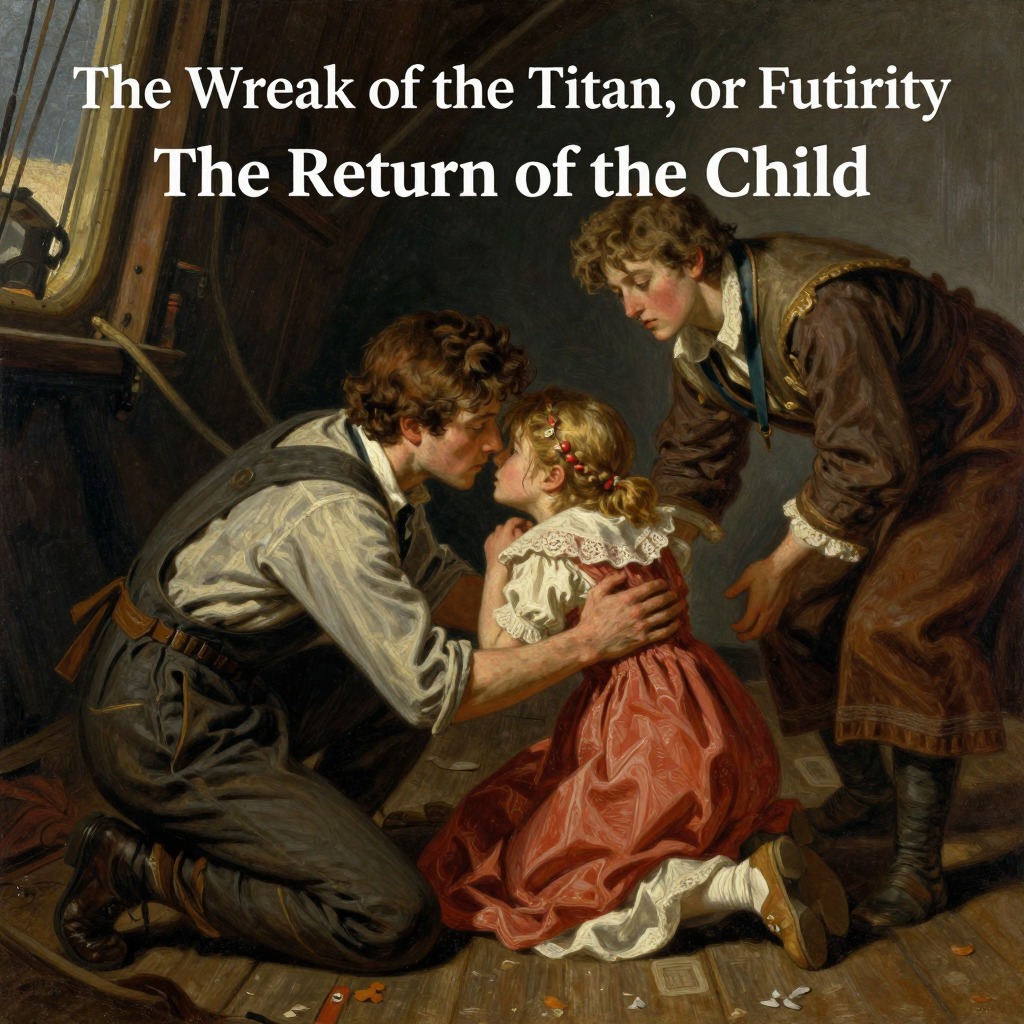
The rescue itself is swift. Fifteen minutes later, Rowland watches the approach of a white quarter-boat from the bark. The crew of the Peerless, commanded by Captain Barry, takes them aboard. Rowland is described as "pale, and weak, with empty left sleeve" when he later appears at Lloyds, but at the moment of rescue he is still whole, though his arm is crushed and his ribs broken. The child, wrapped in Rowland's coat and canvas, is alive but suffering from four deep scratches on her back and a lump on her forehead. The rescue is not a clean deliverance; it is the beginning of a long recovery that will culminate in Rowland's amputation at Christiansand.
Aftermath: The Amputation and the Voyage to England
Rowland's rescue does not end his suffering. He is taken to Christiansand, Norway, where the doctors are forced to amputate his left arm. When he later tells Mr. Meyer at Lloyds, "they cut my arm off at Christiansand, and I still live. That is my escape," he speaks with a bitter irony that underscores the cost of his heroism. The amputation is a direct consequence of the bear fight, which itself was undertaken to save the child. It marks a permanent physical transformation: the once-able seaman is now a cripple, unable to return to the sea as a sailor. Captain Barry later offers him a berth as mate, but Rowland declines, saying, "my going to sea is ended. Even a mate needs two hands." The rescue thus leads not to a restoration of his old life but to a permanent rupture from it.
During the voyage to England on the Peerless, Rowland is nursed by Captain Barry, who becomes his steadfast friend and defender. The crew of the Peerless, moved by the child's plight, lovingly sew her a dress of bagging-stuff with sail-twine in sail-makers' stitches, three to the inch, covering skirts and underclothing made from old flannel shirts. This act of kindness, described in detail, contrasts with the coldness of the Titan's officers and underscores the moral community that forms around Rowland and Myra. The child, who has learned to call Rowland "Dammy," becomes a bond between him and the crew, and her presence softens the harshness of his recovery.
The Significance of the Rescue in Rowland's Arc
The rescue by the Peerless is the turning point in Rowland's moral and spiritual journey. Before the wreck, he is a broken man, consumed by his unrequited love for Myra Gaunt (now Mrs. Selfridge) and by his alcoholism. He has been drugged with hasheesh by the ship's officers to discredit his testimony about the collision with the Royal Age, and he has been driven to the brink of madness. On the iceberg, stripped of everything, he finds a new purpose: the care of the child. His prayer, however ambiguous, marks a shift from his defiant atheism to a tentative openness to the divine. The rescue, coming as it does immediately after the prayer, forces him to confront the possibility that his earlier beliefs were wrong.
This moment also sets the stage for his later actions. The rescue brings him to England, where he testifies at Lloyds about the collision and the drugging, leading to the ruin of Captain Bryce and Mr. Austen. It also brings him into contact with Mr. Selfridge, the child's grandfather, and ultimately leads to his journey to New York to return Myra to her mother. The rescue, in other words, is the hinge on which the entire second half of the novella turns. Without it, Rowland would have died on the iceberg, and the truth about the Titan's recklessness would have remained buried. The rescue thus has both personal and narrative significance: it saves Rowland's life and gives him a future, but it also enables the exposure of the company's crimes and the reunion of mother and child.
In the end, the rescue is not just a physical salvation but a moral one. Rowland, who once declared that he would "do one good, strong act in my useless life," finds that act in saving Myra. The rescue by the Peerless is the moment when that act is recognized and rewarded, and when Rowland begins to believe that his life might have meaning after all. The novel's final line, "And the man went to see—Myra," suggests that the rescue has set him on a path toward a new life, one in which he can finally let go of the past and embrace the future.